
IsoCamp 2025
Updated: Jan 7
Written by: Madison Haumschild, MSc. Student

With winter rapidly descending upon us, it’s nice to reflect upon warmer memories in the Bishop Lab! Last June, Ben Peterson and I had the opportunity to attend IsoCamp 2025 in Albuquerque, New Mexico. This two week intensive course focused on all things stable isotopes! We learned about how biotic and abiotic processes influence stable isotope values as well as the broad applications of stable isotope analysis in the fields of biology, geology, and anthropology. Hosted by the University of New Mexico Albuquerque, IsoCamp was attended by roughly 50 students and 30 instructors from across the country and globe.
The UNM Center for Stable Isotopes has been hosting IsoCamp annually since 2021. Prior to that, IsoCamp was held at the University of Utah starting in 1996. Some of the instructors teaching this past summer were students at the very first IsoCamp in 1996! It was so neat to hear their stories and learn how the use of stable isotope analysis has evolved over the years.
The course consisted of lectures by instructors from all over the world who specialized in a variety of disciplines, ranging from animal ecologists to botanists to forensic scientists. The course also involved a great deal of field and lab work. Ben and I had to quickly adjust to performing field work during New Mexico’s summer in the arid desert. We both have had our fair share of working outside in unfavorable conditions. In November of 2024, Ben and I assisted with the necropsy of a beached fin whale in Anchorage’s -4°F weather. That felt much more comfortable to us than sucking in the hot, dry air and standing in temperatures easily exceeding 100°F in June, resembling conditions of desiccators in the lab. Once we got used to chugging water and finding shade, it wasn’t so bad.
Ben and I collected samples with our lab group near the Cochiti Dam on the Rio Grande River.
During our field work, we collected samples from a variety of plants near the Rio Grande River. We planned to analyze historical fish samples from as early as 1938 to 1999 to look for changes in their diet before and after the completion of the Cochiti dam in 1975. Prior to the placement of the dam, the Rio Grande river would flood, causing the input of nutrients from a slew of terrestrial sources. After the dam was placed, this flooding was heavily reduced and the nutrient input in the river likely underwent a large change. Working with members of the Newsome Lab and other graduate students from across the country, we were hoping to determine if there was a significant change in nutrient source after the dam was built. Fortunately, stable isotopes are a great tool for answering a question like this!
Once we collected all of our samples, we headed back to the lab to prepare our samples to undergo stable isotope analysis. Being able to learn about these methods and techniques hands-on with the Newsome Lab was a huge motivator for taking this course. We got our samples ready to submit to the lab and let Laura Burkemper, a compound-specific isotope master technician at UNM, handled processing them!
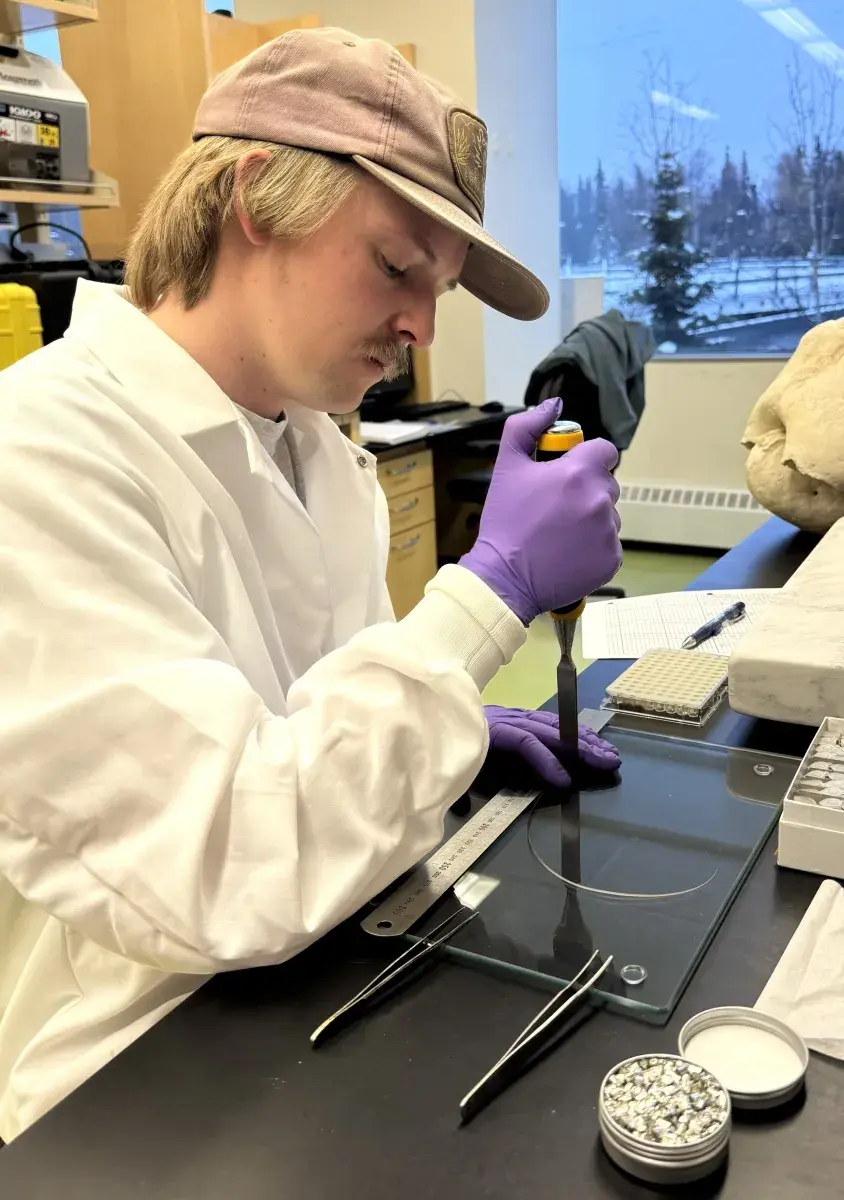
Dr. Emma Elliott Smith, a postdoctoral fellow in the Newsome Lab, helps Ben and I prepare fish muscle samples for stable isotope analysis (left). We also homogenized plant samples for analysis (right).
Within the diets of fish, we found a shift towards algae as a primary producer post-dam completion in 1975. Prior to this, our results indicated that terrestrial sources of carbon were much more prominent in fish diets. We were so excited to be able to apply stable isotope analysis to answer our research question!

Dr. Emma Elliott Smith, a postdoctoral fellow in the Newsome Lab, helps Ben and I prepare fish muscle samples for stable isotope analysis (left). We also homogenized plant samples for analysis (right).
As Master’s students who are both utilizing stable isotope analysis in our research, this course was very important to Ben and me. I plan to use stable isotopes as tracers for mercury contaminants in female grey seals and their pups. On the other hand, Ben is applying stable isotope analysis to assess niche overlap and individual responses between Steller sea lions and northern fur seals during recent marine heatwaves in the Bering Sea. What can’t stable isotopes do?!
A really special part about IsoCamp for both of us was the opportunity to meet other researchers from all over the world who are working to answer really interesting questions! IsoCamp cultivates a really unique community and environment for learning and growing. Socializing and networking with everyone caused both Ben and I to think about our research from other perspectives.
IsoCampers enjoyed beautiful views on the hike in the Sandia Mountains.
Our trip wasn’t all work, though! One morning, IsoCampers woke up early to beat the heat before a hike in the Sandia Mountains in the Cibola National Forest. After a week in the desert, we were happy to see so much green! Missing our Alaskan mountains at home, we were thrilled to get out hiking! Afterwards, we enjoyed some much-earned food and competed in the IsoCamp 2025 horseshoe tournament! Attempting to make our Bishop Lab community proud, my horseshoe partner and I got to the finals, but Ben and his partner took the gold!

Ben and his horseshoe partner earned the title of IsoCamp 2025 Horseshoe Champions!
All in all, Ben and I had a blast in Albuquerque and learned a ton about stable isotopes this past June! We feel so fortunate to have been able to attend and are already utilizing what we’ve learned in our research as we begin to receive and analyze our own stable isotope analysis results!


Comments